Why Every Agricultural Researcher Still Needs to Truly Understand ANOVA
Open almost any agronomy or crop science paper published this year and you’ll see the same four letters in the Materials & Methods section: ANOVA.
It has been there for decades and, despite all the talk of machine learning and genomic selection, ANOVA remains the backbone of 90 % of field-trial conclusions.
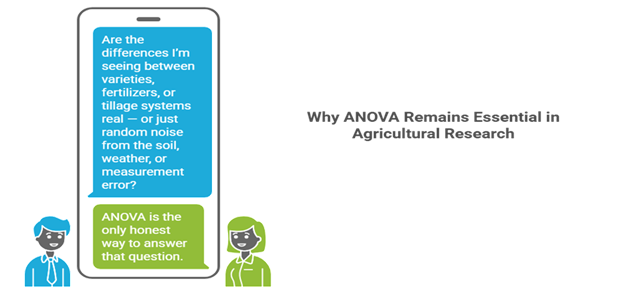
Why? Because ANOVA is the only honest way to answer the question every farmer actually cares about:
“Are the differences I’m seeing between varieties, fertilizers, or tillage systems real — or just random noise from the soil, weather, or measurement error?”
What ANOVA Really Does in the Field
It simply partitions the total variation you observed into two parts:
- Variation caused by your treatments (the signal you hope exists).
- Variation caused by everything else (soil patches, border effects, cloudy days, etc.).
If the first part is clearly larger than the second, you have a significant result you can trust and recommend to farmers.
When ANOVA Becomes Mandatory
You need ANOVA (or its correct modern version) any time you have:
- A proper experimental design with replication and randomization (RCBD, split-plot, factorial, lattice, etc.).
- More than two treatments to compare.
- Field or greenhouse data with natural background noise.
In short: almost every serious agronomy, horticulture, soil science, or plant protection study.
The Most Common (and Dangerous) Mistakes Young Researchers Still Make
Even in 2025, these errors kill more papers than p-hacking ever did:
- Laying out a perfect split-plot (e.g., irrigation as main plot, varieties as sub-plots) but analyzing everything as one big completely randomized design → wrong error terms → false significance.
- Forgetting to include blocks in the model even though the field was blocked → inflated significance.
- Treating repeated harvests from the same plot (ratoons, multiple cuts) as independent observations → massive Type I error.
- Running ordinary ANOVA on 80 genotypes with only three replications instead of using an incomplete-block or lattice analysis → experimental error becomes huge → nothing is significant.
- Analyzing percentages, counts, or disease scores without transformation → assumptions violated → unreliable p-values.
The Golden Rule Nobody Says Out Loud
Your ANOVA model must exactly match the design you physically laid out in the field or greenhouse.
If the design has blocks → blocks go in the model (usually as random).
If it’s split-plot → you need two error terms.
If harvests are repeated on the same plot → you need a repeated-measures or mixed model.
Break this rule and the software will happily give you beautiful p-values that mean absolutely nothing in the real world.
The Shift Happening Right Now
Smart researchers have already moved from old “aov()” to modern mixed models (lme4, asreml, SAS PROC MIXED) because they handle split-plots, repeated measures, spatial trends, and incomplete blocks elegantly in one framework.
But the core logic is still ANOVA: separate signal from noise using the structure of your design.
Bottom Line
In 2025, journals no longer accept vague lines like “data were subjected to ANOVA”.
They want to see exactly how the model respected your randomization, blocking, and plot structure.
Master the connection between experimental design and the correct ANOVA (or mixed model), and you will never again receive the reviewer comment that ends careers:
“Statistical analysis is inappropriate for the experimental design.”
Instead, your results will be trusted by scientists, extension officers, seed companies, and — most importantly — farmers.
It isn’t new.
But when used correctly, it is still the most powerful tool we have to turn messy field data into reliable recommendations that feed the world.
So before you click “Run” one more time, ask yourself one question:
Does my statistical model perfectly reflect what I actually did on the ground?
If the answer is yes, you’re ready to publish.
If not, fix it now — your career (and the farmers who will use your variety) will thank you.
Ready to Finish Your Research Faster?
Offer Ends Tonight—Don't Miss This Opportunity!
Farm Scholars
PHD Success, Guaranteed.
Company
Stay Connected
Follow us on social media for the latest research insights and thesis tips.
© 2025 FarmScholars. All Rights Reserved. | Designed By Ropa Carlos.