
The One Decision That Makes or Breaks Your Research Career
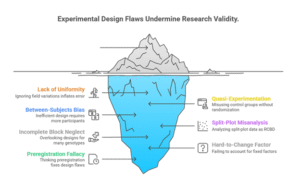
You can have perfect lab techniques, beautiful R code, preregistration on OSF, and 10,000 citations…
But if you chose the wrong experimental design at the beginning, your entire study is scientific garbage wearing a lab coat.
Yet every year, thousands of MSc/PhD students and early-career researchers pick the wrong design — not because they are stupid, but because nobody taught them better.
Here are the 7 most common (and most dangerous) mistakes I see today — and how to fix them before you waste two years and a lots of money.
Mistake 1 – “CRD is fine, the field looks uniform”
Reality: No field is ever uniform.
New researchers love Completely Randomized Design because it’s simple in SPSS.
Result: soil fertility gradients, drainage patterns, and border effects inflate error terms → you miss real treatment differences → negative result → “nothing worked”.
Fix: Always start with Randomized Complete Block Design (RCBD) in the field. Block along the obvious gradient (slope, soil color, previous yield map). Only use CRD in pots on the same greenhouse bench.
Mistake 2 – Calling everything with a control group an “experiment”
Reality: If you didn’t randomize, it’s not an experiment.
I still see theses titled “Effect of X on Y” using alternation, hospital arrival order, or farmer’s choice as “randomization”. That’s quasi-experimental at best — and usually just observational with extra steps.
Fix: If true randomization is impossible, be honest: call it quasi-experimental, use difference-in-differences or propensity score matching, and stop claiming causality in the title.
Mistake 3 – Using between-subjects when within-subjects is obviously better
Reality: You need 4× more participants/plots to detect the same effect.
Example: testing three fertilizer rates on maize yield → most new researchers give each plot only one rate.
Correct: apply all three rates to the same plot in different years (with proper rotation) or use split-plot in space.
Fix: Ask: “Can the experimental unit receive more than one treatment?” If yes → repeated measures, crossover, or split-plot.
Mistake 4 – Split-plot layout but RCBD analysis
Reality: The single most common fatal error in agronomy theses today.
Irrigation or tillage as whole-plot, varieties as sub-plot → data analyzed as RCBD → irrigation effect looks significant at p<0.001 even when it’s noise.
Fix: Learn the two error terms rule. Whole-plot factor → tested against whole-plot error. Everything else → tested against sub-plot error. One wrong line in your code = rejected paper.
Mistake 5 – “I have 100 genotypes, so I’ll just use RCBD with 3 reps”
Reality: You now have 300 tiny plots and massive experimental error.
Alpha-lattice, row-column, or augmented designs exist for exactly this situation.
Fix: 40+ genotypes → switch to incomplete block designs. The agricolae package in R makes it painless.
Mistake 6 – Ignoring the hard-to-change factor
Reality: You want to test irrigation × variety × fertilizer.
You make 4×6×5 = 120 tiny plots and try to randomize everything → irrigation ends up with zero true replication.
Fix: Hard-to-change factors (irrigation, tillage, temperature, grazing) always go to the largest plot level (whole-plot, strip-plot, or whole-block).
Mistake 7 – Thinking preregistration fixes bad design
Reality: Preregistering a terrible design just gives you a time-stamped terrible design.
Open Science fixed p-hacking, not bad methodology.
Fix: Preregister the design justification too. Ask yourself: “Which specific threats to internal validity does my design control — and which ones does it leave open?”
The 30-Second Rule for Choosing the Right Design
Before you write your proposal, answer these four questions:
- What is the experimental unit? (plot, animal, pot, child, hospital…)
- Which factor is physically hardest or most expensive to apply? → largest plot
- Is there one major source of variation I can see right now? → block on it
- Can the same unit receive multiple treatments safely? → repeated measures / within-subjects
Write the answers on a sticky note. If your design doesn’t match the answers, change the design.
Final Truth
- In 2025, journals are rejecting more papers for “fundamental design flaws” than for p-hacking.
Statistical sophistication went up. Design literacy went down. - The researchers who will dominate the next decade are not the ones with the fanciest mixed-models or the biggest datasets.
- They are the ones who can look at a research question and — in under five minutes — sketch the one design that actually answers it without lying to farmers, patients, or policymakers.
- Don’t be the person who spent three years collecting beautiful data from the wrong experiment.
- Choose the right design on day one.
- Everything else is just details.
- (Now go redraw your field plan before you plant this season.) 🌱
Drop your research question in the comments — I’ll tell you the correct design in one sentence.
Ready to Finish Your Research Faster?
Offer Ends Tonight—Don't Miss This Opportunity!
Farm Scholars
PHD Success, Guaranteed.
Company
Stay Connected
Follow us on social media for the latest research insights and thesis tips.
© 2025 FarmScholars. All Rights Reserved. | Designed By Ropa Carlos.